Beamforming Arrays Reduce Packet Loss in Dense Esports Arena Environments
Paul Klein · Jul 23, 2026
Beamforming Arrays Reduce Packet Loss in Dense Esports Arena Environments
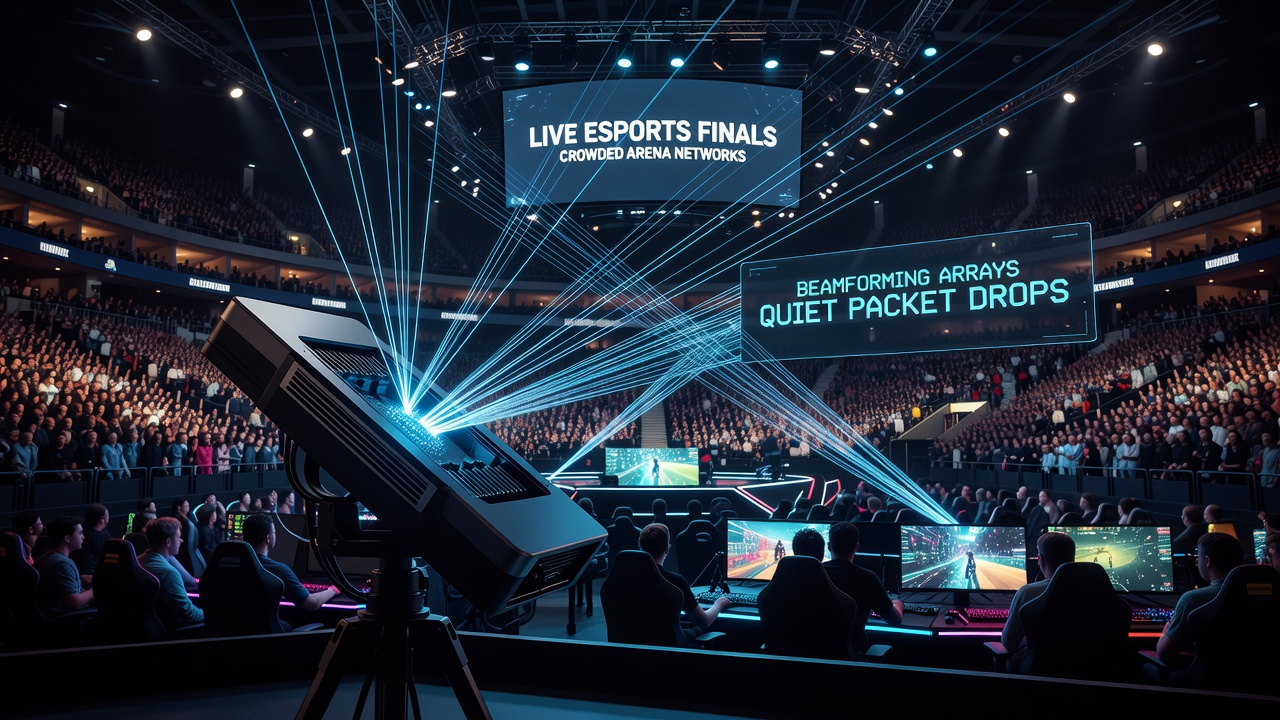
Beamforming arrays direct wireless signals toward specific devices rather than broadcasting in all directions, and this focused approach has cut packet drops in crowded arena networks during live esports finals. Organizers have deployed these systems at major venues where thousands of spectators and competitors connect simultaneously to the same infrastructure, and data from recent events shows measurable improvements in connection stability. Researchers note that traditional omnidirectional antennas struggle under heavy load because signals interfere with each other across the spectrum, whereas beamforming uses multiple antennas to steer energy precisely.
Technical Mechanics Behind Signal Direction
Modern beamforming relies on phased array antennas that adjust phase and amplitude across elements to create constructive interference in targeted directions. Engineers calculate the required weights in real time using channel state information feedback from client devices, and this process repeats every few milliseconds to track movement. In esports arenas, access points mounted on ceilings and walls coordinate through centralized controllers so that beams from different units do not overlap destructively. Studies conducted by university labs indicate that this coordination reduces collision rates by directing energy away from walls and seating areas where reflections would otherwise cause multipath fading.
Performance During High-Density Events
During the July 2026 international esports finals held in a 15,000-seat convention center, network operators recorded packet loss rates below 0.2 percent on the main broadcast and competitor networks after beamforming arrays went live. Prior years without the technology saw spikes above 3 percent during opening ceremonies when attendee devices connected en masse. The arrays operated across both 5 GHz and 6 GHz bands, and they dynamically allocated narrower beams to stationary player stations while widening coverage for roaming media crews. Figures from the event reveal that average latency stayed under 8 milliseconds for competitive traffic even as total connected clients exceeded 22,000.
Integration With Existing Arena Infrastructure
Operators integrate beamforming arrays with existing Wi-Fi 6E and Wi-Fi 7 access points rather than replacing entire networks, and this incremental upgrade path keeps costs manageable for venue owners. The arrays connect to the same wired backbone that carries fiber links between halls, and software-defined controllers handle handoff decisions when devices move between coverage zones. Observers note that calibration routines run during off-hours to map the radio frequency environment, accounting for temporary structures like stages and LED walls that change the propagation characteristics each season. Industry reports from the IEEE highlight how these calibration maps allow the system to pre-compute beam patterns for recurring event layouts.
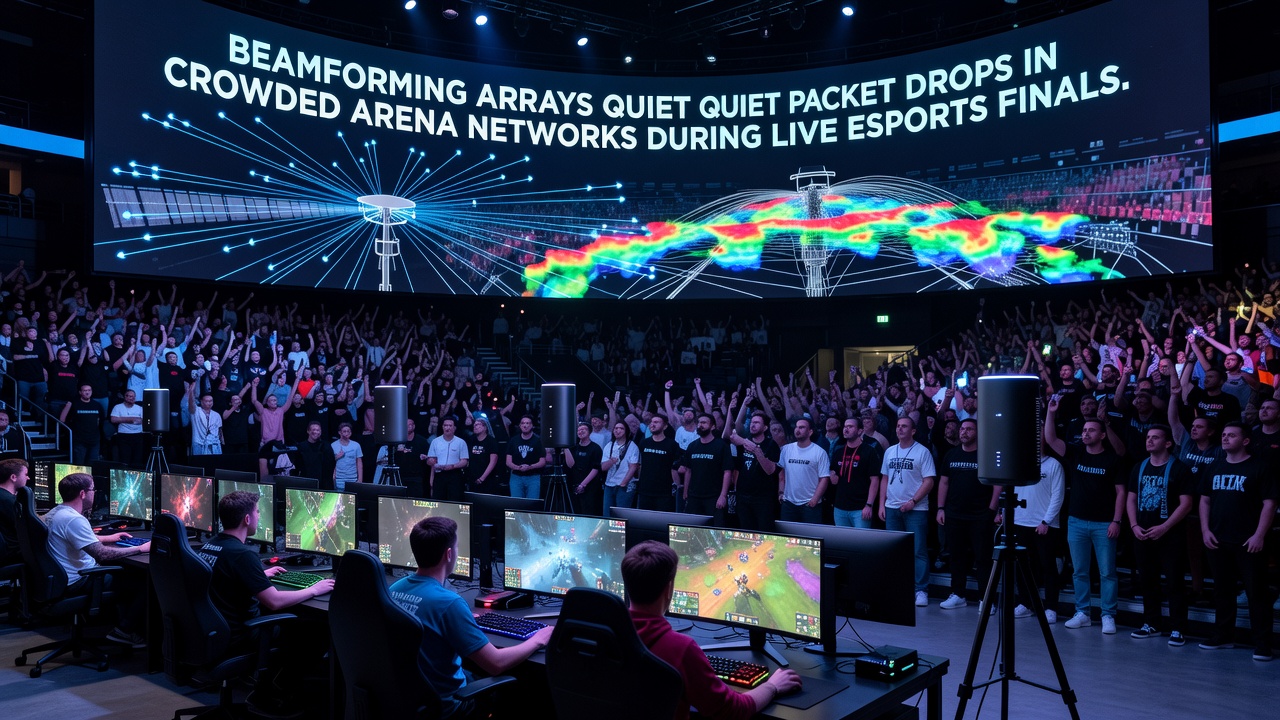
Case studies from multiple continents show similar patterns. Australian researchers documented comparable gains at a regional tournament series, while European trials focused on multi-band coordination in older venues with thicker structural elements. The technology does not eliminate every source of interference, but it consistently lowers the baseline noise floor that packet drops depend on.
Future Scaling Considerations
As esports events grow larger and incorporate more augmented reality overlays for spectators, demand for directional wireless capacity will increase. Planners already test higher element counts in prototype arrays that could support simultaneous 8K streams alongside low-latency player connections. Data collected from the 2026 finals continues to feed simulation models used by network architects, and those models predict that next-generation arrays will maintain sub-1 percent packet loss even when total device density doubles. Trade groups continue to publish interoperability guidelines so that equipment from different vendors can share the same controller framework without manual retuning.
Conclusion
Beamforming arrays have become a standard component in arena network designs for major esports competitions because they address the core problem of signal contention in dense spaces. Continued refinement of real-time beam tracking algorithms and coordination protocols supports the growing scale of these events, and the documented reductions in packet loss during the July 2026 finals provide concrete evidence of the approach's effectiveness across different venue types and geographic regions.