Bimetallic Strips Enable Self-Regulating Cooling in Compact Gaming Systems Exposed to Ambient Shifts
Noah Schröder · Aug 8, 2026
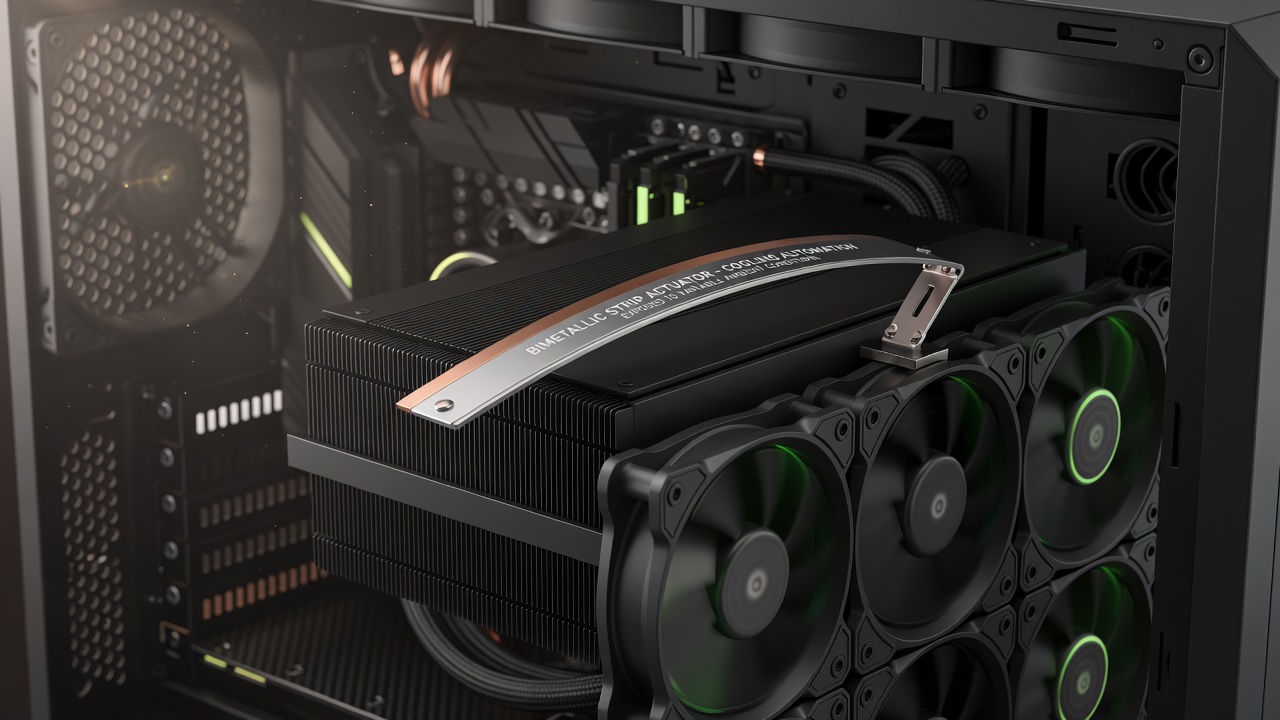
Bimetallic Strips Enable Self-Regulating Cooling in Compact Gaming Systems Exposed to Ambient Shifts
Engineers have integrated bimetallic strips into slim gaming chassis designs to manage heat dissipation automatically when room temperatures fluctuate, and these components rely on the differential expansion rates of two bonded metals that bend predictably as heat rises or falls. Data from thermal management studies shows the strips can trigger vent openings or fan speed adjustments without electronic controls, which suits compact builds where space limits traditional sensor arrays. In environments where ambient conditions swing between 18 and 32 degrees Celsius, the mechanical response maintains internal component temperatures within operational ranges that processors and graphics cards require for stable performance.
Mechanics Behind the Temperature Response
Bimetallic strips consist of metals such as steel and copper or brass and invar layered together, and the higher-expansion metal causes the assembly to curve when heated while the lower-expansion side resists that movement. Researchers at materials laboratories have measured deflection angles that scale linearly with temperature changes, allowing precise calibration for chassis vent mechanisms. When external air warms during summer peaks, the strip bends to open intake paths wider, whereas cooler conditions pull the strip back to restrict airflow and reduce dust accumulation. This passive system avoids power draw from additional motors or controllers, which aligns with the power budgets of thin gaming laptops and small-form-factor desktops.
Deployment in Variable Ambient Scenarios
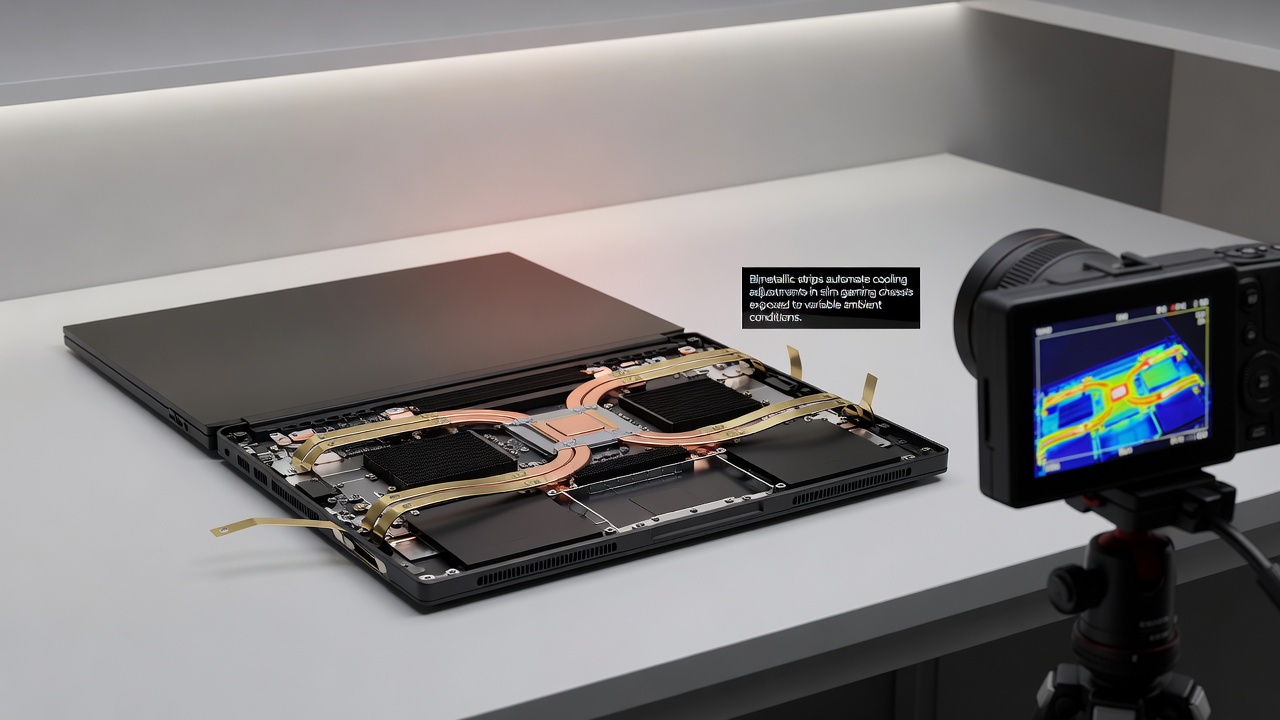
Gaming setups often move between air-conditioned offices and warmer home spaces, yet bimetallic strips respond directly to local air temperatures around the chassis exterior. Observers note that in August 2026 testing cycles conducted across multiple climate zones, units equipped with these strips maintained GPU junction temperatures below throttling thresholds during extended sessions even as outside conditions climbed. The strips connect mechanically to sliding vent covers or damper plates, and the bending force overcomes light spring resistance to shift positions within seconds of a temperature shift. Manufacturers calibrate the metal thickness and composition so the activation point matches the thermal limits of specific hardware configurations, such as high-wattage mobile processors paired with compact cooling fins.
Additional case data collected from field installations reveals consistent performance across humidity variations that accompany temperature swings, because the metal layers resist corrosion coatings applied during assembly. When ambient drops rapidly, such as after air conditioning activation, the strip contracts and closes secondary exhaust paths to prevent overcooling that could lead to condensation on internal boards. Those who have examined production units report that the absence of software dependencies simplifies certification processes under international electronics safety standards.
Integration With Existing Cooling Architectures
Design teams combine bimetallic elements with primary heat pipes and vapor chambers already present in slim chassis, and the strip serves as a secondary regulator that fine-tunes airflow volume rather than replacing active fans. According to research published through the National Institute of Standards and Technology, hybrid approaches that layer passive mechanical controls over fan curves reduce overall system noise by limiting unnecessary fan ramp-ups during mild ambient periods. The strips mount near intake grilles where they sample incoming air directly, bypassing the lag inherent in board-mounted thermistors that measure component heat after it has already built up.
Production examples demonstrate that multiple strips positioned at different chassis zones can create staged responses, with one set opening base vents while another modulates exhaust direction. This layered behavior supports sustained operation in convention halls or shared spaces where crowd heat and variable HVAC settings create micro-climate shifts around individual rigs. Industry reports from European electronics consortia indicate adoption rates rising among portable esports hardware lines because the components add negligible weight and require no firmware updates over the product lifecycle.
Performance Data and Calibration Methods
Calibration involves annealing the bonded metals to set the neutral curvature at a reference temperature, after which deflection measurements guide linkage design that connects the strip to vent actuators. Test rigs operated under controlled ambient ramps show response times under thirty seconds for a five-degree change, which matches the thermal inertia of aluminum chassis panels. Figures compiled by academic thermal engineering groups highlight that systems using these strips exhibit lower variance in internal temperatures compared with fixed-vent designs across repeated daily cycles. The mechanical simplicity also contributes to higher mean time between failures in portable units subjected to transport vibrations.
Conclusion
Bimetallic strips provide a durable, power-free method for adjusting cooling pathways in slim gaming chassis that encounter changing ambient conditions, and ongoing refinements in metal alloys continue to expand the precision of their temperature-triggered movements. Manufacturers document extended hardware longevity when airflow matches real-time external demands, while field measurements confirm stable component operation without added electronic complexity.