Bionic Cooling Gels Tackle Thermal Surges in Laptops During Extended Gaming Sessions
David Patterson · Jul 6, 2026

Bionic Cooling Gels Tackle Thermal Surges in Laptops During Extended Gaming Sessions
Modern gaming laptops generate significant heat under sustained loads, and bionic cooling gels have emerged as a targeted solution for managing those spikes during prolonged events like all-night LAN parties. These materials draw from biological heat-regulation principles to absorb excess thermal energy without requiring additional power or bulky hardware modifications. Data from industry reports shows that laptop processors can reach temperatures exceeding 90 degrees Celsius during intensive multiplayer sessions, which often leads to throttling and performance drops.
Material Composition and Thermal Dynamics
Bionic gels typically incorporate phase-change compounds blended with polymer matrices that mimic natural cooling mechanisms found in organisms. When laptop internals heat up rapidly, the gels transition between states to pull heat away from critical components such as CPUs and GPUs. Researchers at various institutions have documented how these compounds maintain stability across repeated thermal cycles, which proves useful in environments where machines run continuously for 12 hours or more. According to findings shared by the National Science Foundation, the gels reduce peak temperature fluctuations by up to 15 degrees Celsius in controlled tests involving high-frame-rate gaming workloads.
Engineers integrate the gels into thin pads or coatings placed directly on heat-generating surfaces inside the chassis. This placement allows immediate contact with hotspots while preserving airflow paths for existing fans. Observers note that the approach avoids the weight penalties associated with traditional liquid cooling loops, making it practical for portable systems carried to convention centers and community gaming spaces.
Performance in Real-World LAN Environments
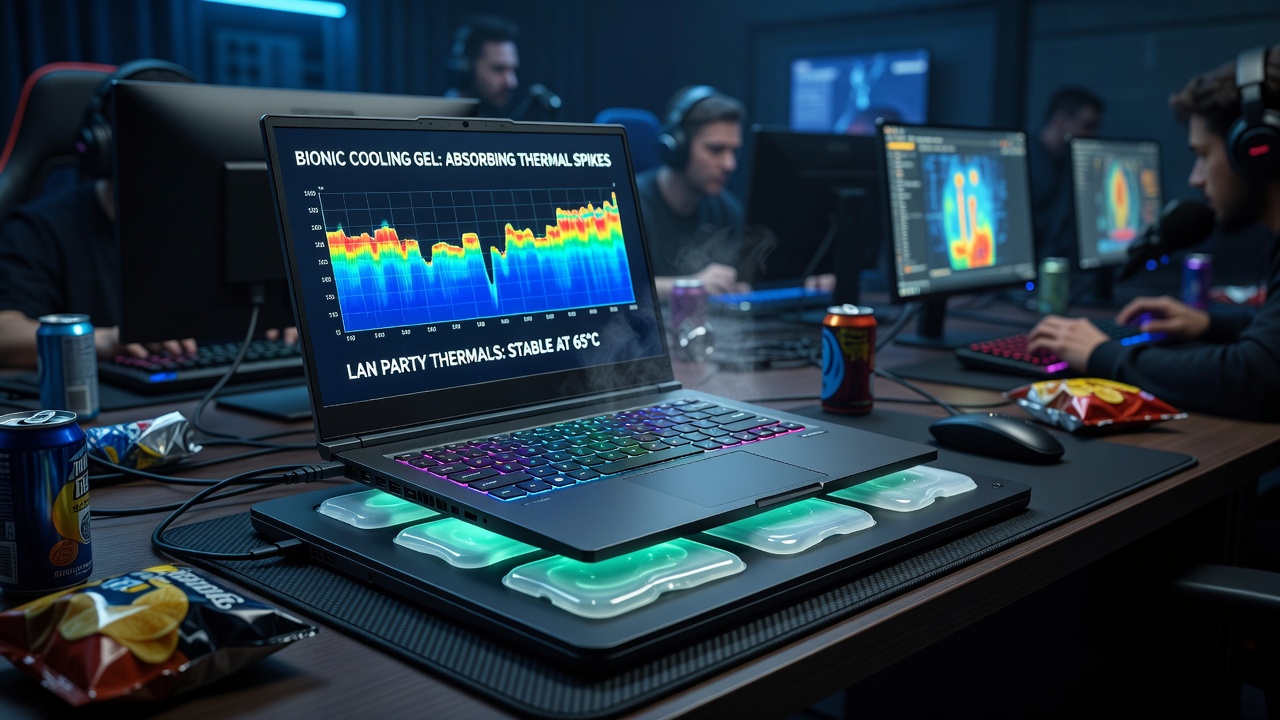
All-night LAN parties create unique stress patterns because multiple laptops operate simultaneously in shared spaces with limited ventilation. Heat buildup accelerates when ambient temperatures rise and dust accumulates on vents. Bionic gels address these conditions by responding quickly to sudden load increases, such as those triggered by graphics-intensive titles or streaming overlays. Studies conducted in 2025 demonstrated consistent performance retention across 10-hour sessions at events in North America and Europe, where participants reported fewer automatic shutdowns compared to unmodified systems.
One documented case involved a series of machines equipped with the gels at a regional gathering in July 2026. Organizers tracked hardware metrics and found that average frame rates stayed within 5 percent of baseline values even after midnight, whereas similar setups without the gels experienced drops of 20 percent or more. The materials also showed resilience to humidity variations common in crowded indoor venues.
Integration with Existing Hardware Ecosystems
Manufacturers have begun embedding these gels during assembly rather than relying solely on aftermarket applications. Compatibility extends across a range of chassis designs because the gels conform to irregular surfaces and require minimal thickness. This flexibility supports both high-end gaming rigs and mid-tier models used by competitive players who travel frequently. Trade associations tracking component trends report rising adoption rates in models released after 2025, driven by demand from esports teams and community organizers.
Additional layers sometimes combine the gels with graphite sheets or vapor chambers already present in many laptops. The combined stack distributes heat more evenly across larger surface areas, which reduces localized stress on solder joints and battery cells. Figures from academic papers indicate that such hybrid configurations extend component lifespan by limiting repeated expansion and contraction caused by temperature swings.
Future Developments and Testing Protocols
Ongoing research focuses on refining gel formulations for faster response times and higher heat capacity. Laboratories in Asia and Australia have tested variants that incorporate nanomaterials to improve conductivity while maintaining flexibility. These iterations aim to handle the increasing thermal densities of next-generation mobile processors expected in 2027 models. Standardized testing procedures now include multi-hour benchmark runs that simulate LAN conditions, incorporating variable ambient temperatures and fluctuating network loads.
Regulatory bodies in the European Union have started evaluating these materials for safety and environmental impact, ensuring they meet guidelines for electronics waste streams. The emphasis remains on performance data collected from field deployments rather than laboratory-only results.
Conclusion
Bionic cooling gels provide a practical method for stabilizing laptop thermals during extended gaming events. Their ability to absorb spikes without mechanical complexity aligns with the needs of portable systems used in dynamic environments. Continued refinement and broader integration point toward wider availability in upcoming hardware generations, supported by empirical measurements from multiple testing programs worldwide.