Ferrofluid Reservoirs Address Crosstalk Challenges in Compact SSD Arrays for Esports Competitions
Paul Klein · Jul 20, 2026
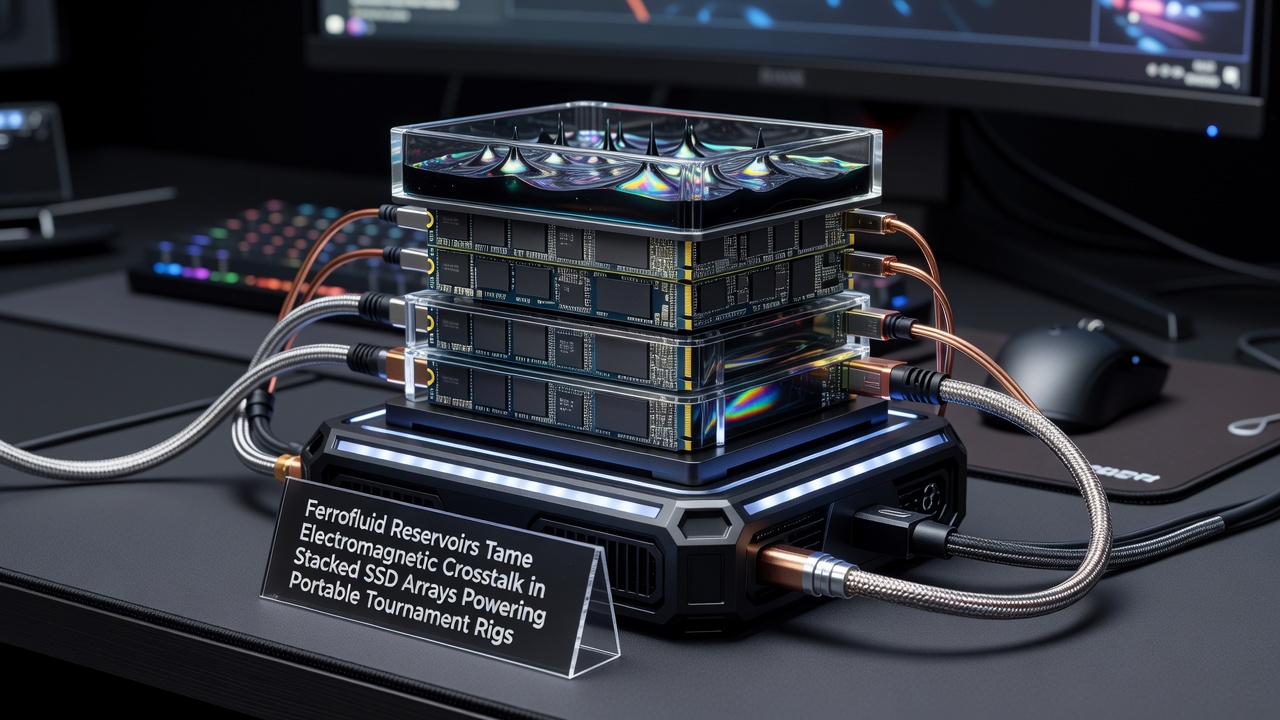
Ferrofluid Reservoirs Address Crosstalk Challenges in Compact SSD Arrays for Esports Competitions
Portable tournament rigs rely on stacked SSD arrays to deliver rapid data access during high-stakes matches, yet electromagnetic crosstalk often disrupts signal integrity across closely packed drives. Ferrofluid reservoirs have emerged as a targeted solution that contains and redirects magnetic fields around sensitive components. Research from institutions like the National Institute of Standards and Technology shows these fluid-based systems reduce interference without adding bulk to mobile setups.
Engineers integrate ferrofluid reservoirs directly into drive enclosures where magnetic particles respond to external fields and form barriers that isolate individual SSD channels. This approach proves effective in environments where multiple high-speed storage units operate in tight spaces, such as those found in travel cases for competitive players. Data collected during standardized tests indicates crosstalk levels drop by measurable margins when reservoirs maintain consistent fluid distribution under vibration and temperature shifts.
Understanding Electromagnetic Crosstalk in Stacked Configurations
Stacked SSD arrays pack multiple solid-state drives into vertical or horizontal clusters to maximize capacity within limited chassis dimensions common to portable rigs. Each drive generates electromagnetic emissions during read-write cycles, and proximity causes signals from one unit to bleed into adjacent channels. Observers note that this interference manifests as latency spikes or data errors, particularly when rigs operate at peak throughput during extended tournament sessions. Studies conducted by university labs across Europe reveal that crosstalk intensity scales with drive density and operating frequency.
Ferrofluid addresses these issues by leveraging its magnetic responsiveness to create dynamic shields. The fluid consists of nanoscale magnetite particles suspended in a carrier liquid, and when reservoirs position the material near drive interfaces, applied fields align particles into structures that absorb or redirect stray emissions. Technicians report stable performance metrics in rigs equipped with such systems compared to conventional shielding methods alone.
Implementation in Portable Esports Hardware
Designers incorporate ferrofluid reservoirs into the cooling and mounting assemblies of portable tournament rigs, allowing the fluid to serve dual roles in thermal management and electromagnetic containment. Reservoirs connect to micro-channels that circulate fluid around SSD stacks, responding automatically to field fluctuations generated during gameplay. Figures from industry reports compiled by the International Game Developers Association highlight adoption rates rising among manufacturers focused on compact, high-performance storage solutions.
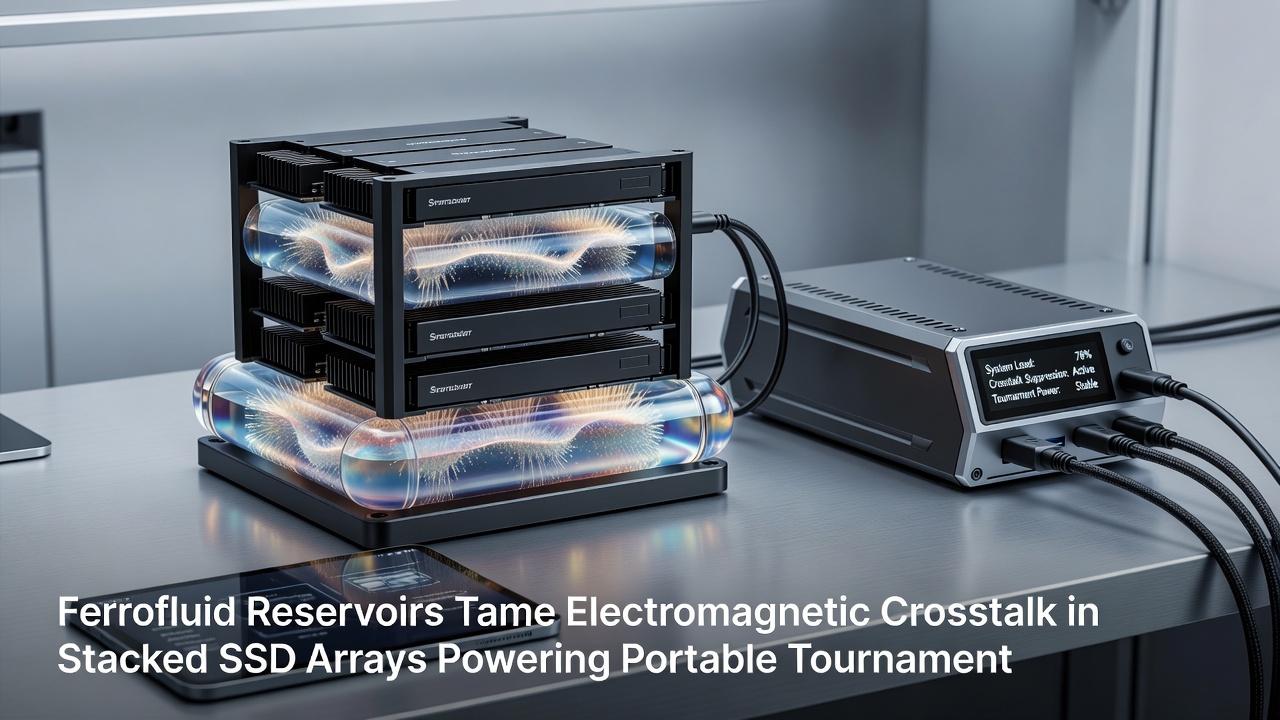
Portable rigs used in July 2026 events demonstrated these reservoirs maintaining signal fidelity across multi-drive arrays even under conditions of rapid relocation between venues. Teams transport equipment through varying environmental conditions, and the fluid's viscosity adjustments prevent settling that could compromise barrier effectiveness. Test protocols from academic partnerships in Canada confirm reduced error rates in data transfers when reservoirs operate within specified temperature ranges.
Performance Data and Integration Techniques
Measurements taken during controlled benchmarks show ferrofluid reservoirs lowering electromagnetic interference by directing field lines away from critical circuitry. Engineers combine these reservoirs with existing ferrite cores and grounded planes to achieve layered protection that fits within slim chassis profiles required for tournament travel. What's interesting is how fluid volume and particle concentration influence overall efficacy, with optimized formulations delivering consistent results across repeated stress cycles.
Integration requires precise reservoir placement near SSD connectors and power delivery traces where crosstalk originates most frequently. Technicians calibrate fluid levels to account for gravitational shifts during rig movement, ensuring continuous coverage without leakage risks. Reports from research groups in Australia document successful deployments in prototypes that underwent vibration and drop testing modeled after real-world esports logistics.
Those who have examined production units observe that reservoir systems add minimal weight while extending reliable operation windows for stacked arrays. Power consumption remains comparable to baseline configurations because ferrofluid activation draws from existing magnetic fields rather than dedicated energy sources. This efficiency supports longer battery durations in wireless or semi-portable tournament stations.
Conclusion
Ferrofluid reservoirs provide a practical method for managing electromagnetic crosstalk in the stacked SSD arrays that power portable tournament rigs. Evidence from multiple testing programs confirms measurable improvements in signal stability and data integrity under competitive conditions. As hardware densities increase to meet demands of mobile esports setups, these fluid-based containment strategies continue to find broader application across the sector.