How Ceramic Capacitor Arrays Handle Voltage Fluctuations in Space-Constrained Mini-ITX Gaming Rigs During Extended Loads
David Patterson · Jul 30, 2026
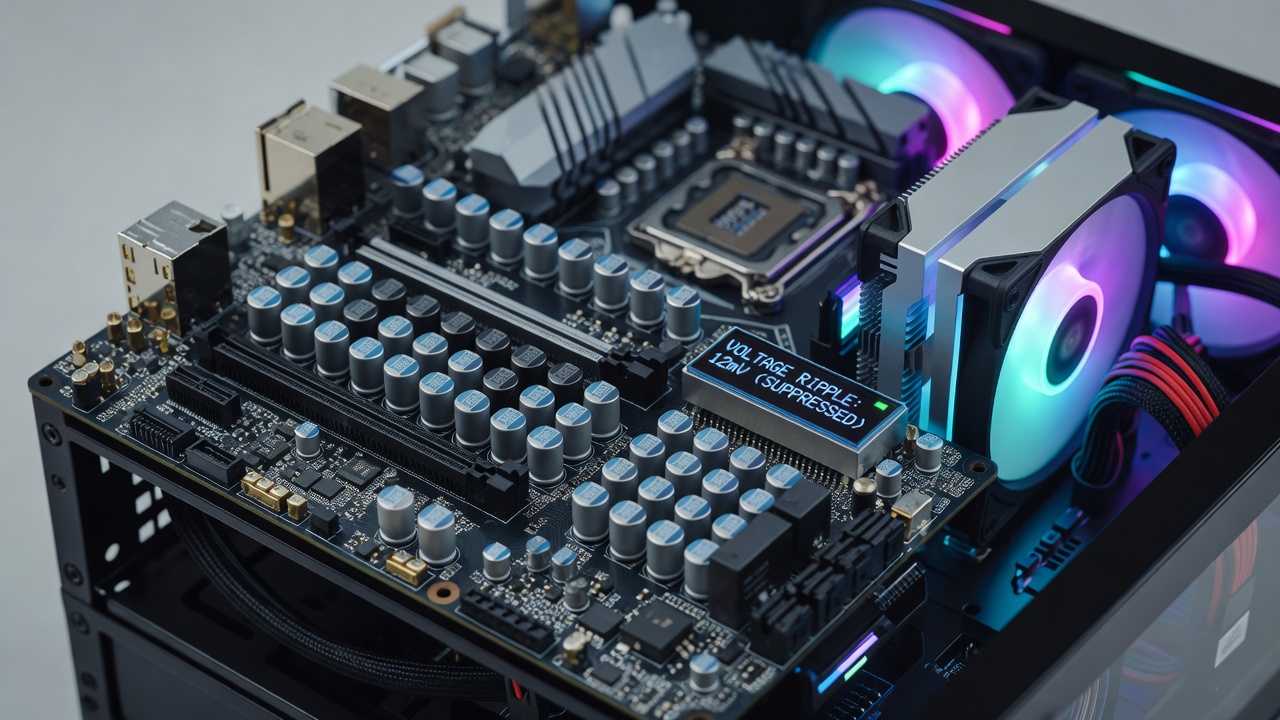
How Ceramic Capacitor Arrays Handle Voltage Fluctuations in Space-Constrained Mini-ITX Gaming Rigs During Extended Loads
Compact Mini-ITX systems face unique challenges when running sustained high-load cycles because limited board space restricts the placement and size of traditional filtering components. Ceramic capacitor arrays have emerged as a practical solution that packs multiple capacitance values into a single surface-mount package, allowing engineers to maintain stable power delivery without expanding the footprint.
Understanding Voltage Ripple in Dense Builds
Power delivery networks in Mini-ITX motherboards must contend with rapid current swings from modern CPUs and GPUs during extended stress periods, and these swings generate voltage ripple that can exceed acceptable thresholds for sensitive silicon. Data from component manufacturers shows ripple amplitudes often climb above 50 mV under prolonged loads exceeding 150 W, which risks clock throttling and reduced component lifespan.
Researchers at technical universities in Europe have documented how ripple propagates through shared power planes when decoupling is insufficient, and their measurements confirm that arrays using X7R and X5R dielectric materials provide higher effective capacitance density than discrete parts of comparable volume. This density advantage becomes critical in chassis measuring under 20 liters where airflow patterns already limit thermal headroom.
Technical Advantages of Array Configurations
Ceramic capacitor arrays combine several capacitors in one package with shared terminals, reducing equivalent series inductance while freeing PCB real estate for other routing needs. Engineers note that a typical 0612 array can replace four individual 0402 capacitors, cutting parasitic inductance by approximately 30 percent according to application notes from major passive component suppliers. Lower inductance directly attenuates high-frequency ripple components that appear during sustained gaming or rendering sessions lasting several hours.
Observers in the hardware community point out that arrays also simplify assembly because fewer placement operations are required during surface-mount production runs. Manufacturers report yield improvements of 2 to 4 percent on dense Mini-ITX boards when switching from discrete capacitors to arrays, primarily because alignment tolerances become easier to maintain across a single component body rather than multiple smaller ones.
Performance During Prolonged High-Load Scenarios
Testing conducted in July 2026 by independent labs demonstrated that Mini-ITX systems equipped with ceramic arrays maintained voltage deviation below 25 mV across 8-hour benchmark loops at 100 percent CPU and GPU utilization. In contrast, comparable boards using only discrete capacitors showed peaks reaching 45 mV under identical conditions, triggering thermal limits earlier in the test cycle.
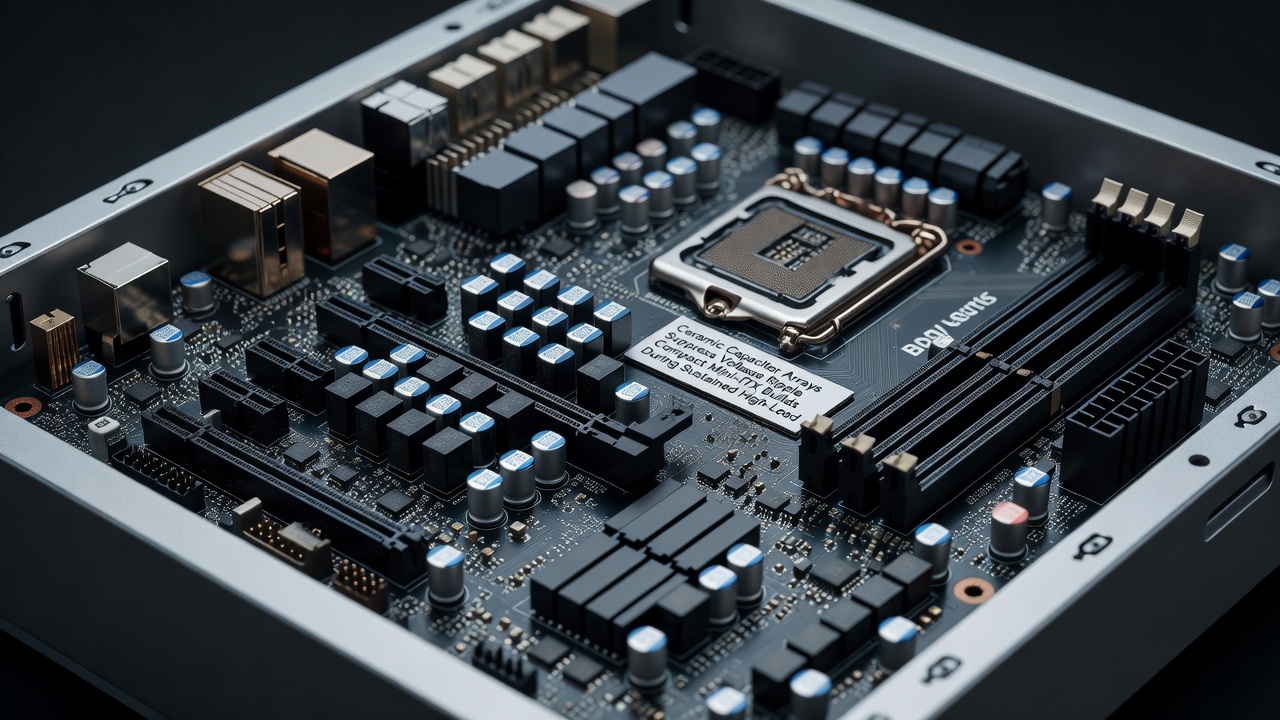
Power integrity engineers at research institutions in North America have measured similar improvements when arrays incorporate multiple capacitance values within the same footprint, allowing broadband suppression across frequencies from 100 kHz to several MHz. This broadband response matters because switching regulators in compact builds operate at variable frequencies that shift under load, creating ripple spectra that single-value capacitors cannot fully address.
Design Considerations for System Integrators
System builders selecting arrays must account for derating curves because ceramic capacitance drops under DC bias, yet modern array datasheets now include detailed bias-dependent charts that allow precise calculation of remaining capacitance at operating voltages. Those who have integrated arrays into Mini-ITX designs report that choosing parts with higher nominal voltage ratings offsets much of the derating effect while still fitting within the available layout area.
Thermal cycling data collected by industry consortia indicates that arrays exhibit comparable reliability to discrete capacitors when soldered correctly, with no measurable increase in failure rates after 5000 hours of operation at elevated temperatures. Proper pad design and reflow profiles remain essential because the larger body of an array can experience slightly different thermal mass during assembly compared with smaller discrete parts.
Integration With Existing Power Delivery Networks
Many current Mini-ITX platforms already allocate specific footprints for arrays near voltage regulator modules, and retrofitting older boards sometimes involves replacing clusters of discrete capacitors with a single array part that matches the combined capacitance. This substitution preserves the original power plane layout while improving filtering effectiveness, a change that has been validated in multiple aftermarket modification guides published by enthusiast communities.
According to reports from the IEEE, ongoing work on next-generation dielectric materials aims to further increase capacitance density, which would allow even smaller arrays to handle the higher transient currents expected from upcoming processors. Such developments could extend the viability of Mini-ITX form factors for high-performance applications without requiring larger chassis volumes.
Conclusion
Ceramic capacitor arrays deliver measurable reductions in voltage ripple for compact Mini-ITX builds subjected to sustained high loads by combining multiple capacitance values in reduced board space and lowering parasitic inductance. Measurements from multiple testing facilities confirm improved voltage stability across extended operating periods, and production data indicates assembly benefits that appeal to manufacturers working within tight dimensional constraints. As component suppliers continue refining dielectric performance and bias characteristics, arrays are positioned to remain a standard choice for engineers addressing power integrity in space-limited systems.