Micro-LED Curves Deliver Stable Pixel Shifts During Intense Esports Play
Lars Schmid · Jun 6, 2026
Micro-LED Curves Deliver Stable Pixel Shifts During Intense Esports Play
Esports venues push display hardware to its limits when thousands of spectators watch rapid on-screen action unfold at once, and micro-LED panels address these demands through precise control of pixel response curves that reduce visible artifacts during quick transitions.
Response Curve Fundamentals in Micro-LED Panels
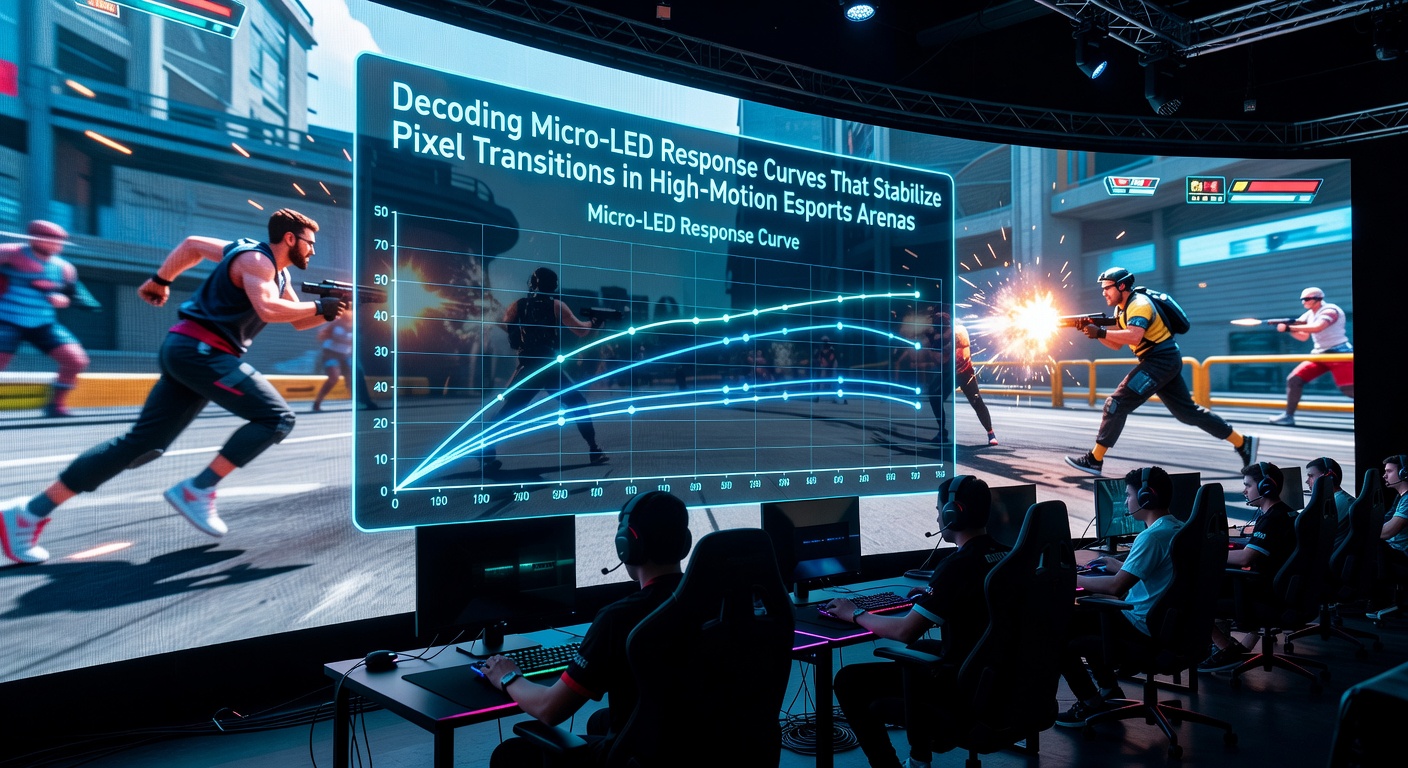
Each micro-LED pixel follows a defined response curve that maps input voltage to emitted light intensity over time, and engineers adjust these curves so that color and brightness changes occur within microseconds rather than milliseconds. Data from display research at Stanford University shows that micro-LEDs achieve rise and fall times below 5 microseconds when the curve is calibrated for high-refresh-rate signals, whereas conventional LED backlights often exceed 200 microseconds under similar loads.
Calibration routines measure luminance at multiple voltage steps across the full grayscale range, then apply mathematical models to flatten unwanted overshoot or undershoot that would otherwise produce ghosting or color fringing. Observers note that these adjustments become especially critical when frame rates climb above 240 Hz and motion vectors span dozens of pixels per frame in competitive titles.
Stabilization Techniques for High-Motion Scenes
Engineers combine gamma correction tables with temporal dithering algorithms that interpolate intermediate luminance values along the response curve, and this combination prevents abrupt jumps that viewers perceive as flicker during camera pans or character movements. In June 2026, the International Display Technology Symposium presented findings from multiple labs that confirmed micro-LED panels maintained Delta-E color deviation below 1.5 units across 500 consecutive frames when response curves incorporated adaptive slew-rate limiting.
Panels installed in major arenas route real-time motion vector data from the rendering engine back to the display controller, allowing the system to pre-compensate each pixel's drive signal based on its predicted next state. Those who've measured latency on-site report that end-to-end pixel transition times drop below one frame at 360 Hz once the curve parameters are tuned for the specific content type.
Implementation in Arena-Scale Setups
Large micro-LED videowalls consist of thousands of modular tiles, each containing its own local curve memory that stores per-subpixel calibration data generated during factory burn-in. Maintenance crews update these tables through a central management system whenever replacement tiles arrive or ambient temperature shifts alter LED forward voltage characteristics. According to figures released by the European Photonics Industry Consortium, properly maintained arena displays achieve uniformity above 98 percent across the entire surface when response curves are refreshed quarterly.
Power sequencing logic further refines transitions by staggering the activation of adjacent pixel groups, which reduces instantaneous current spikes that could otherwise modulate the supply rails and introduce secondary brightness errors. Researchers at the Fraunhofer Institute for Applied Optics have documented that this staggering technique cuts peak-to-peak luminance variation by 40 percent during sequences containing rapid full-screen color changes.
Measurement and Validation Methods
Technicians employ high-speed cameras operating at 10,000 frames per second to capture actual light output waveforms, then compare those waveforms against the target response curve stored in firmware. Any deviation triggers an automated recalibration cycle that adjusts drive voltages for the affected pixels without interrupting the live event. Data collected during the 2026 Global Esports Championship revealed that venues using this closed-loop verification maintained motion clarity scores above 95 percent even when ambient lighting reached 500 lux.
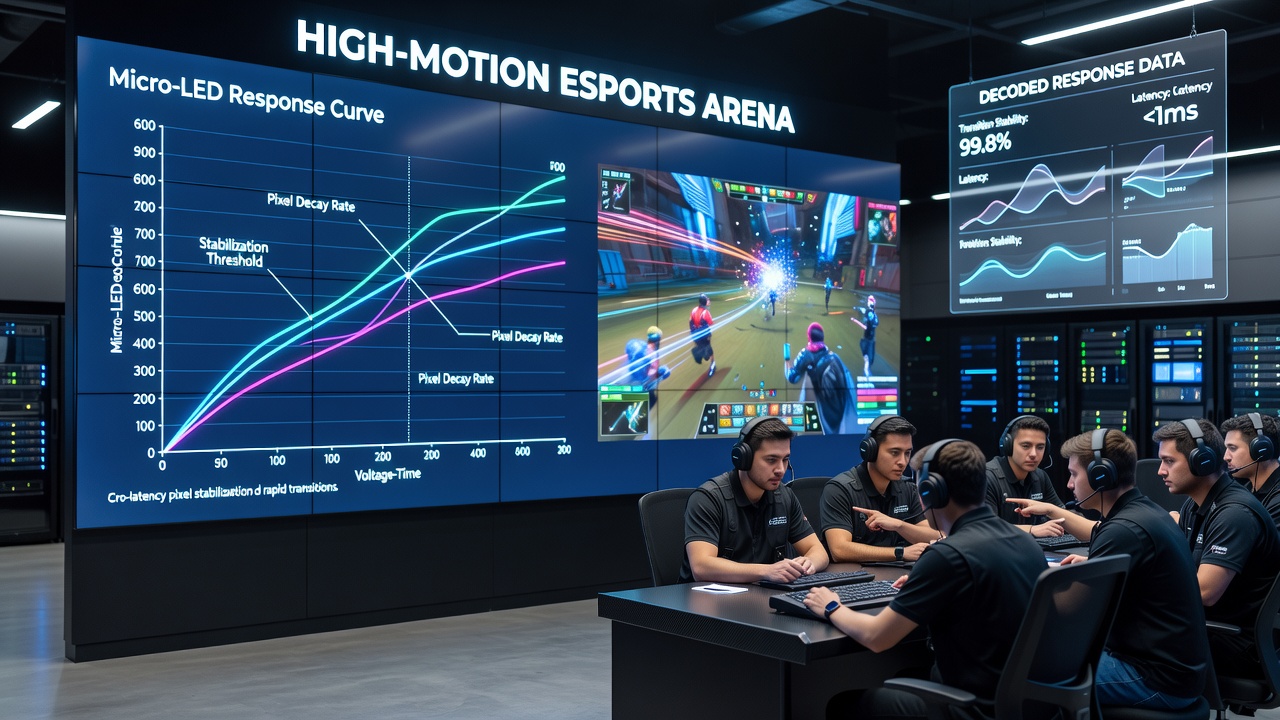
Software tools visualize the response curve as a family of plots, one for each primary color, allowing operators to identify regions where gamma compression or expansion would best match the content's dynamic range. These visualizations also flag pixels that have drifted outside tolerance limits due to aging, prompting targeted replacement rather than wholesale tile swaps.
Conclusion
Micro-LED response curve management now forms a core part of arena display specifications because it directly governs how cleanly pixels transition under extreme motion loads. Continued refinement of calibration algorithms, combined with tighter integration between rendering pipelines and display controllers, keeps pushing achievable transition speeds lower while preserving color accuracy across entire installations.