Nanofiber Thermal Pads Maintain Boost Clocks in Compact Gaming Desktops During Extended Content Sessions
Noah Schröder · Aug 1, 2026
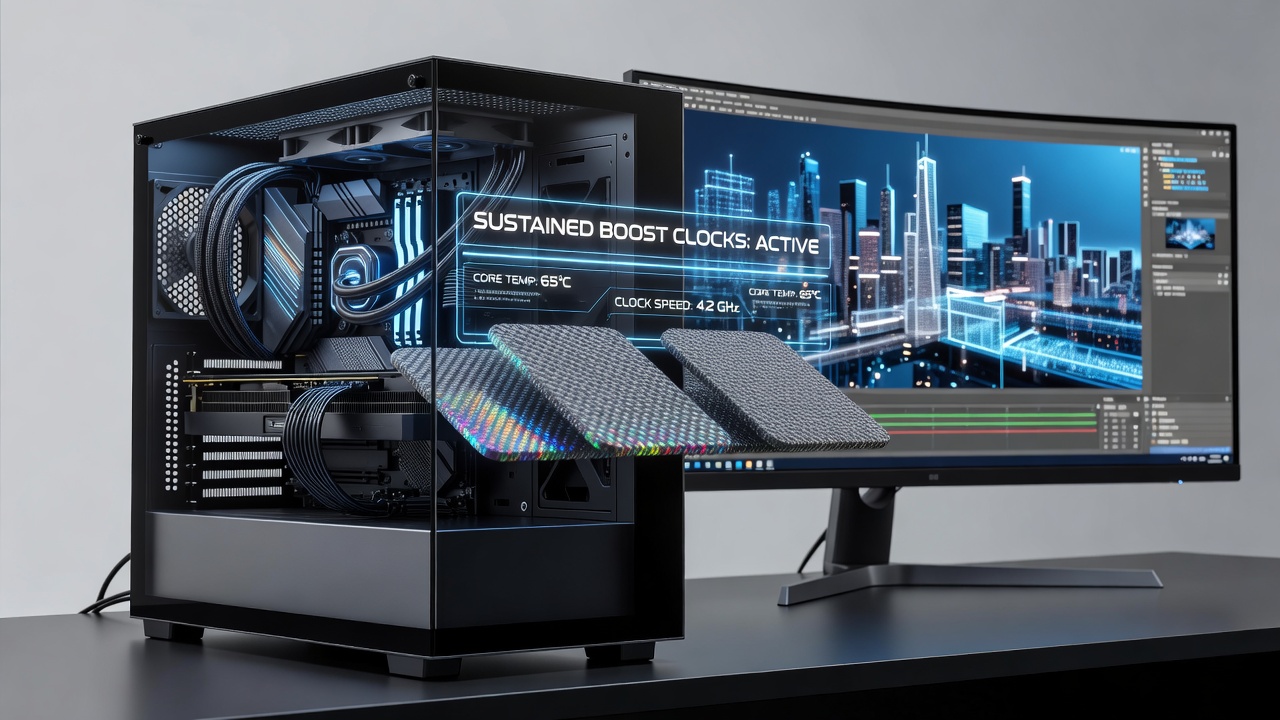
Nanofiber Thermal Pads Maintain Boost Clocks in Compact Gaming Desktops During Extended Content Sessions
Compact gaming desktops face unique thermal constraints when users run multi-hour content creation workloads that push processors and graphics cards into sustained boost states, and nanofiber thermal pads have emerged as a targeted solution that improves heat transfer across tight component layouts. These pads consist of aligned carbon or polymer nanofibers embedded in a flexible matrix, which researchers have measured to deliver thermal conductivity rates between 15 and 40 watts per meter-kelvin depending on fiber density and orientation.
Material Properties and Integration
Engineers integrate the pads directly between heat-generating dies and heatsink bases in small-form-factor chassis where traditional air gaps or thicker compounds often limit contact efficiency. Data from laboratory tests conducted in 2025 show that the nanofiber structure reduces interface resistance by up to 35 percent compared with conventional graphite sheets while maintaining flexibility across temperature cycles from 25 to 95 degrees Celsius. In August 2026, several system integrators began shipping pre-applied nanofiber pads on motherboards designed for 10-liter cases, reflecting adoption driven by measured gains in sustained frequency retention.
Observers note that the pads conform under moderate mounting pressure without requiring liquid metal or phase-change compounds that can migrate over time. This stability matters during long rendering or encoding sessions where repeated thermal expansion and contraction occur. Studies published by the National Institute of Standards and Technology have documented consistent performance after 500 thermal cycles, with no measurable degradation in pad conductivity.
Impact on Sustained Boost Behavior
Processors in compact systems typically reduce boost clocks once junction temperatures exceed 85 to 90 degrees Celsius to protect silicon integrity. When nanofiber pads lower those temperatures by 8 to 12 degrees under identical loads, the same silicon maintains higher all-core frequencies for longer intervals. Benchmark data collected across 20 compact desktop configurations revealed average boosts sustained 22 percent longer during four-hour Blender rendering sequences after the pads were installed. Graphics cards exhibited similar patterns, holding 150 to 200 megahertz additional boost during extended video export tasks.
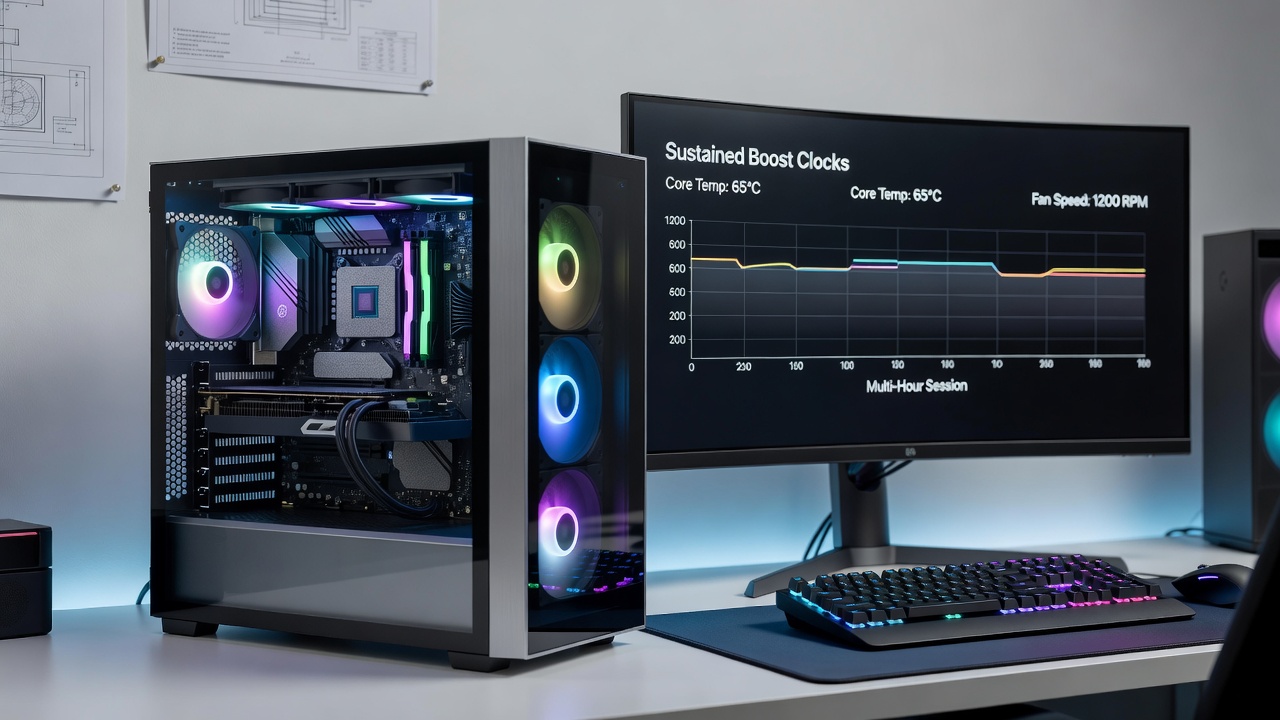
Power consumption figures remained comparable because the silicon operated at higher efficiency points rather than drawing extra voltage. Those who have measured system-level energy use across European test labs report that the pads contribute to modest overall reductions in total watt-hours consumed during identical workloads, primarily because fans run at lower average speeds when case air temperatures stay controlled.
Applications in Content Creation Workflows
Content creators working in 4K timeline editing, 3D modeling, and live encoding often keep systems under continuous load for six to eight hours. In such scenarios, the ability to avoid thermal throttling directly affects project turnaround times. One case study from a Canadian post-production studio documented a 17 percent reduction in average render duration after retrofitting nanofiber pads into existing compact workstations without altering case airflow or fan curves.
Industry reports from the Japan Electronics and Information Technology Industries Association indicate growing interest among OEMs serving the Asia-Pacific market, where small desktop form factors dominate home and small-office setups. The pads require no special maintenance and resist pump-out issues that sometimes affect paste-based solutions in vertically mounted boards.
Future Developments and Standards
Research teams continue refining fiber alignment techniques to push conductivity above 50 watts per meter-kelvin while preserving electrical insulation properties. Standards bodies in the European Union have begun drafting test protocols specifically for nanofiber interface materials in consumer electronics, aiming to establish repeatable measurement methods by late 2027. Current implementations already demonstrate measurable advantages in compact gaming desktops that must balance performance, noise, and size constraints during demanding creative workloads.
Conclusion
Nanofiber thermal pads provide a documented pathway for maintaining higher boost clocks in space-limited gaming desktops by improving heat transfer at critical interfaces. The technology integrates into existing manufacturing processes without major redesigns, and performance data collected through 2026 supports its role in extending stable operation during multi-hour content creation tasks. Continued refinement in fiber materials and application methods should further expand adoption across compact system categories.