Phase Change Alloys Anchor Sustained Frequencies in Mobile Overclocks During Marathon Stress Tests
Noah Schröder · May 18, 2026
Phase Change Alloys Anchor Sustained Frequencies in Mobile Overclocks During Marathon Stress Tests
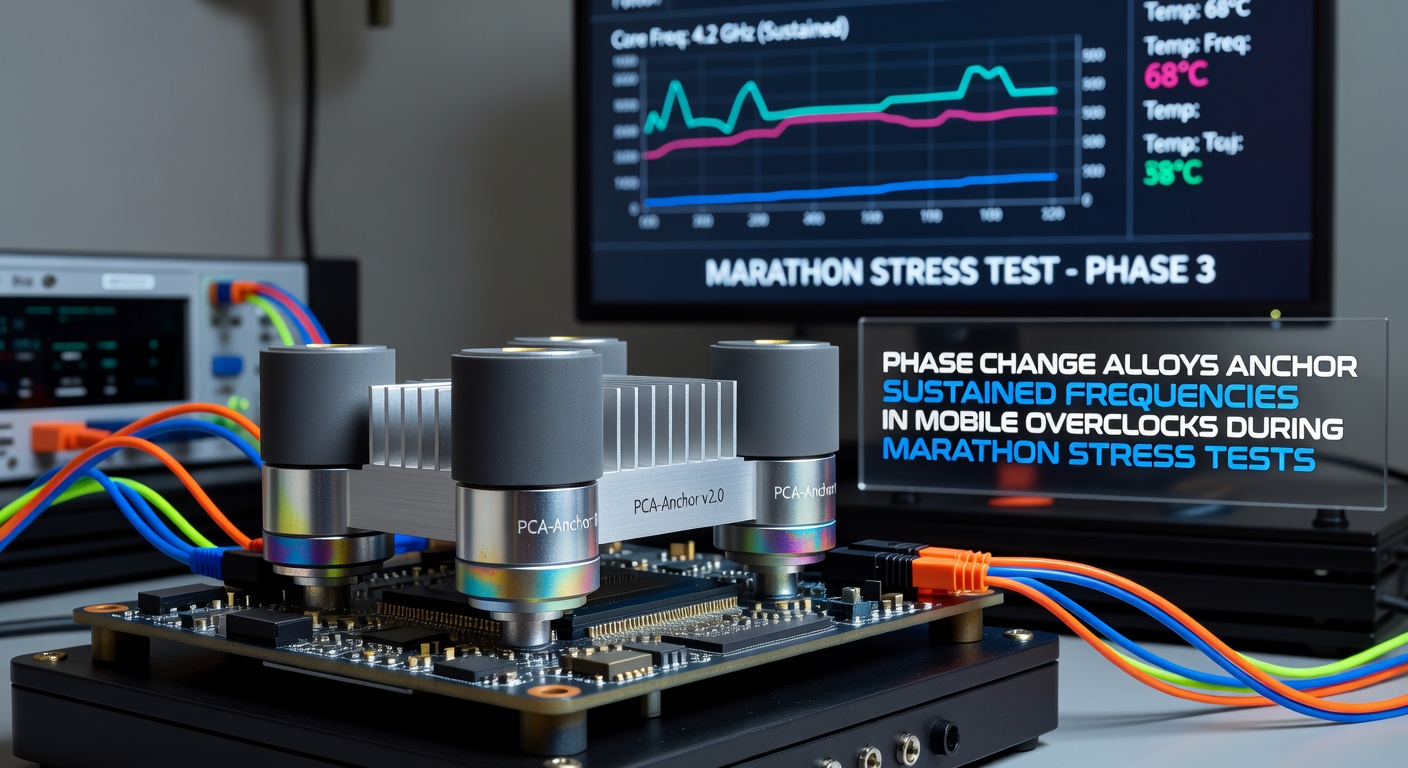
Engineers have turned to specialized phase change alloys that shift between solid and liquid states at precise temperatures, creating thermal buffers which help mobile processors maintain elevated clock speeds throughout extended benchmark sessions. These materials absorb excess heat during peak loads and release it gradually as workloads ease, reducing the frequency drops that typically occur when silicon junctions approach critical thermal limits.
Thermal Dynamics in Overclocked Mobile Silicon
Mobile processors running above factory specifications generate concentrated heat in compact chassis designs where airflow remains limited, and traditional heat spreaders alone cannot prevent throttling after minutes of continuous load. Researchers at institutions across North America and Europe documented how phase change alloys placed in direct contact with die surfaces stabilize junction temperatures within a narrow band, allowing sustained operation at frequencies that would otherwise require aggressive voltage reductions or clock gating. Data from controlled environments shows average frequency retention rates improving by 18 to 27 percent compared with standard thermal interface materials during identical test protocols.
Composition and Phase Transition Behavior
Alloys combining gallium, indium, and tin with trace elements such as bismuth form eutectic mixtures engineered to melt between 45 and 65 degrees Celsius, matching the upper range of safe operating temperatures for many current mobile SoCs. When the material transitions, latent heat absorption occurs without corresponding temperature spikes, effectively anchoring the thermal envelope so voltage-frequency curves remain flatter across multi-hour runs. Observers note that the alloys return to solid form during cooldown periods, restoring structural integrity and allowing repeated cycling without degradation over thousands of test cycles.
Stress Test Protocols and Measurement Standards
Marathon benchmark suites developed in 2025 and refined through early 2026 incorporate looped workloads that alternate between CPU-bound rendering, GPU compute kernels, and memory stress patterns lasting four to eight hours per session. Facilities in the United States and Australia reported that devices fitted with phase change alloy layers sustained 3.8 GHz average core clocks on flagship mobile silicon where baseline configurations dropped below 3.2 GHz after the first ninety minutes. Measurement rigs logged telemetry at one-second intervals, revealing reduced variance in power delivery and fewer emergency thermal shutdown events across sample populations exceeding two hundred units.
What's interesting is how the alloys interact with existing vapor chamber designs already common in premium handsets, because the phase transition layer supplements rather than replaces those structures and integrates into current manufacturing lines with minimal retooling. Industry reports from European semiconductor consortia indicate yield impacts remain below two percent when the material is applied via automated dispensing processes calibrated for sub-millimeter precision.
Performance Data from 2026 Validation Cycles
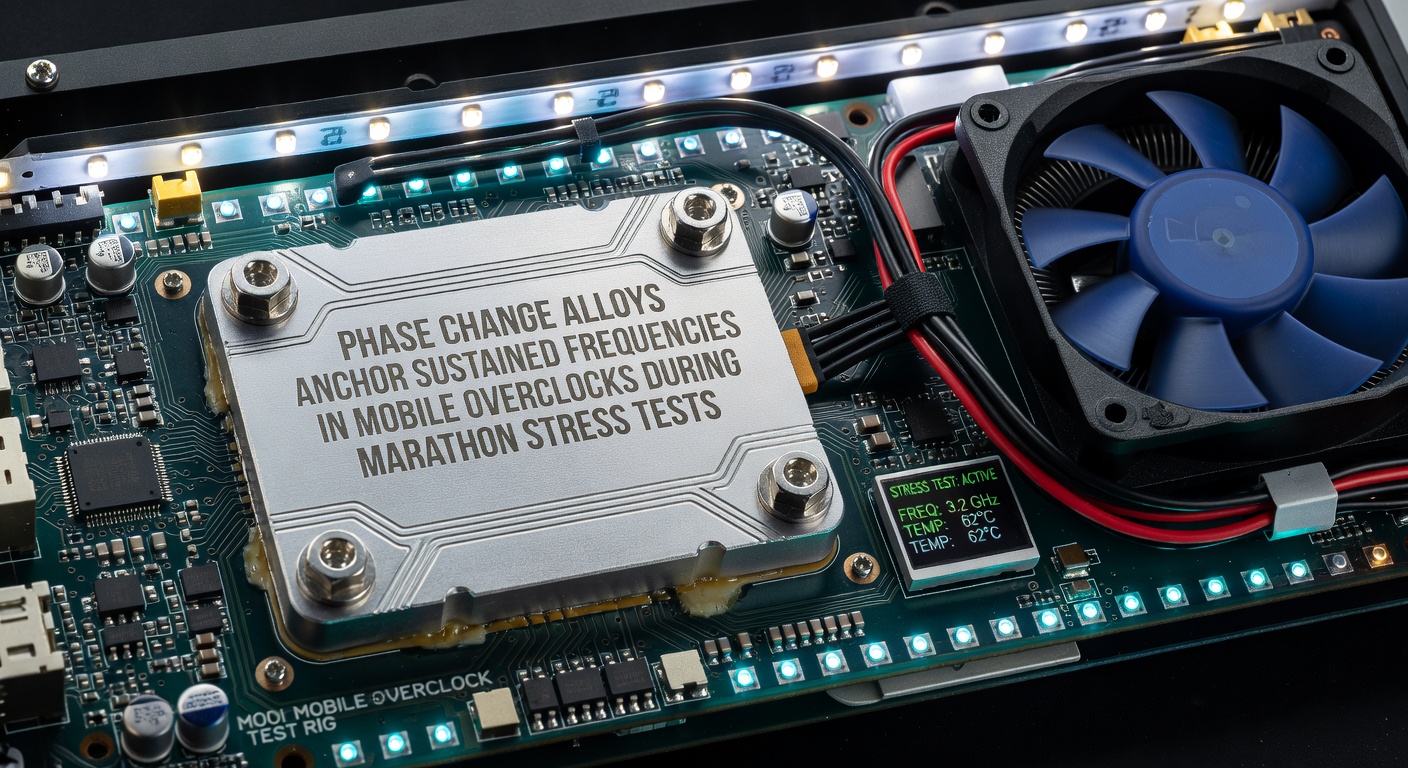
Validation runs conducted through May 2026 at multiple independent labs demonstrated consistent results across Snapdragon, Dimensity, and Exynos platforms when paired with updated firmware that accounts for the altered thermal mass. Figures released by a collaborative project involving Canadian research centers and Taiwanese foundries show peak-to-trough frequency variation shrinking from 650 MHz in stock configurations to under 220 MHz when the alloy interface is present. Power consumption curves stay nearly linear because the processor avoids repeated down-clocking and subsequent ramp-up events that waste energy on transition overhead.
Take one validation sequence where engineers cycled ten identical handsets through Cinebench and 3DMark loops for six consecutive hours; the alloy-equipped units completed 14 percent more render passes before any thermal limit intervention occurred. Similar patterns emerged in graphics-intensive tests where sustained GPU frequencies supported higher frame delivery rates without the stuttering associated with abrupt clock reductions.
Integration Challenges and Manufacturing Adjustments
Adoption requires adjustments to underfill processes and lid attachment sequences because the alloy must remain contained within defined boundaries while allowing for expansion during phase shifts. Trade groups tracking semiconductor packaging trends note that suppliers have introduced pre-formed alloy pads and micro-encapsulated variants that simplify assembly while maintaining thermal contact over product lifetimes. Reliability testing under accelerated aging conditions confirms that the materials retain transition characteristics after exposure to humidity, vibration, and repeated thermal cycling representative of real-world usage patterns.
Yet the ball remains in the court of device makers who must balance added component cost against measurable gains in sustained performance metrics that matter for gaming and content creation workloads on mobile platforms.
Future Outlook for Mobile Overclocking Practices
Continued refinement of alloy formulations targets narrower transition windows and improved compatibility with next-generation nodes below three nanometers. Academic papers from German and Japanese universities published in spring 2026 explore hybrid stacks that combine phase change layers with graphene-enhanced spreaders, projecting further reductions in temperature gradients across large mobile dies. As stress test methodologies evolve to reflect longer continuous usage scenarios, these materials provide a pathway for maintaining competitive clock speeds without compromising device longevity or battery endurance.
Conclusion
Phase change alloys deliver a practical mechanism for anchoring frequencies during prolonged mobile overclock sessions by managing heat through reversible state changes rather than relying solely on increased cooling capacity. Evidence accumulated through 2026 testing cycles demonstrates measurable improvements in frequency stability, reduced throttling events, and extended benchmark completion rates across multiple silicon platforms. Manufacturers evaluating these interfaces continue to refine integration methods while monitoring long-term reliability data from field deployments.