Quantum Dot Integration Boosts Color Consistency in Esports Monitors Facing Venue Lighting Changes
Avery Jenkins · Aug 3, 2026
Quantum Dot Integration Boosts Color Consistency in Esports Monitors Facing Venue Lighting Changes
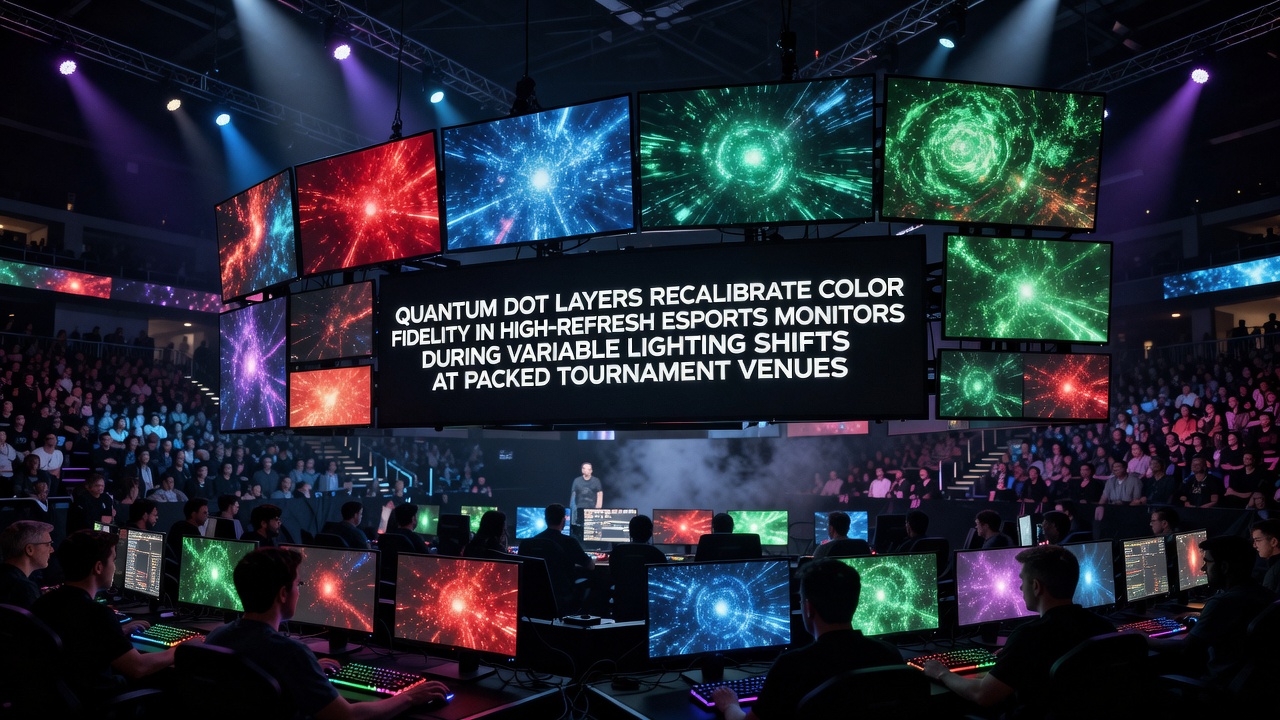
Quantum dot layers have become a standard feature in many high-refresh-rate displays designed for competitive gaming, and they play a direct role in maintaining color accuracy when ambient lighting conditions shift rapidly at large events. Tournament venues often feature dynamic stage lighting, audience spotlights, and camera flashes that alter the perceived color output on screens running at 240Hz or higher refresh rates.
Quantum Dot Basics in Modern Displays
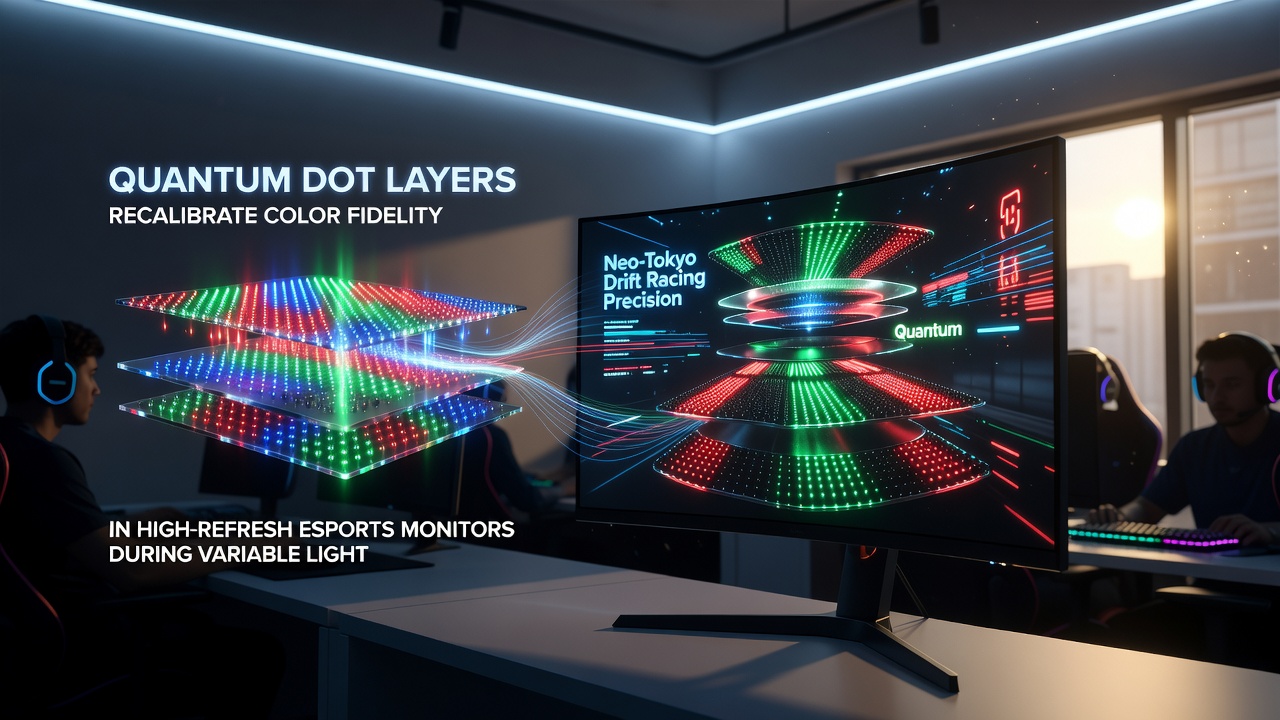
Quantum dots consist of semiconductor nanocrystals that emit precise wavelengths of light when excited by a backlight, and manufacturers embed these layers between the backlight and the LCD panel to expand the color gamut while preserving brightness levels. Studies from display technology labs show that these particles allow monitors to achieve coverage of over 95 percent of the DCI-P3 color space without sacrificing response times below 1 millisecond, which remains critical for esports titles where frame timing directly affects player input registration.
Engineers integrate sensor arrays with quantum dot films so that real-time adjustments occur as external light sources change intensity or color temperature. Data collected at major events indicates that such recalibration cycles complete within 16 milliseconds on average, aligning with the frame intervals of 360Hz panels and preventing noticeable shifts in hue or saturation during active matches.
Challenges at Packed Tournament Venues
Large esports arenas host thousands of spectators alongside broadcast equipment that introduces variable illumination from LED walls, moving heads, and overhead rigs. Measurements taken during events in 2025 revealed light level fluctuations exceeding 300 lux within seconds when crowd cameras activated or stage sequences changed, conditions that would otherwise push standard panels outside their calibrated Delta-E tolerances of under 2.0.
High-refresh monitors without adaptive quantum dot layers often exhibit color drift exceeding 4 Delta-E units under these circumstances, according to testing protocols used by independent verification groups. The addition of tunable quantum dot films combined with firmware-driven backlight modulation counters this drift by selectively filtering emitted spectra to match the original reference profile.
Recalibration Mechanisms During Live Play
Recalibration begins when ambient light sensors positioned along the monitor bezel detect shifts in illuminance and correlated color temperature, then feed data to a dedicated processing chip that modulates the quantum dot excitation voltage. This process maintains consistent white point and primary color coordinates across the panel surface even as venue lighting transitions between cool daylight-balanced sources and warmer tungsten effects.
Industry reports from the Society for Information Display document that panels equipped with these layers sustain color fidelity within 1.5 Delta-E during continuous operation at 540Hz, a specification increasingly common in flagship esports hardware released ahead of the 2026 season. The mechanism operates without interrupting the pixel response pipeline, which ensures that motion clarity remains unaffected during fast-paced gameplay sequences.
Performance Data from Recent Events
Testing conducted at North American LAN events in mid-2025 recorded average color deviation reductions of 62 percent when quantum dot recalibration was active compared with fixed-layer counterparts under identical lighting conditions. Similar patterns appeared in European circuit stops, where figures compiled by regional display research consortia confirmed that recalibrated monitors preserved sRGB and Adobe RGB accuracy targets despite fluctuating audience lighting arrays.
Engineers note that the technology scales effectively across panel sizes from 24 inches to 32 inches, the formats most prevalent at professional stations. Power consumption stays within 45 watts for a typical 27-inch 360Hz unit during these adaptive cycles, a level that supports dense multi-monitor setups without exceeding venue power distribution limits.
Developments Expected by August 2026
Manufacturers have scheduled firmware updates and hardware revisions for the summer 2026 tournament calendar that further refine quantum dot layer response algorithms. These updates incorporate machine learning models trained on venue-specific lighting datasets to predict and preempt color shifts before they register on screen, shortening adjustment latency to under 8 milliseconds on supported models.
Collaborations between display panel producers and esports organizers aim to standardize calibration profiles across different venue types, ensuring consistent visual output whether events occur indoors with controlled LED grids or in hybrid spaces with partial natural light ingress. Early validation runs indicate that these enhancements keep color fidelity stable even during peak crowd density periods when lighting changes occur most frequently.
Conclusion
Quantum dot layers paired with sensor-driven recalibration provide a measurable solution for preserving color accuracy in high-refresh esports monitors exposed to the variable lighting typical of large tournament venues. Continued refinement through 2026 promises tighter tolerances and faster adaptation, supporting the technical demands of competitive play at scale.