Stacked Memory Dies Revolutionize Bandwidth in 8K Gaming Environments
Noah Schröder · Jun 22, 2026
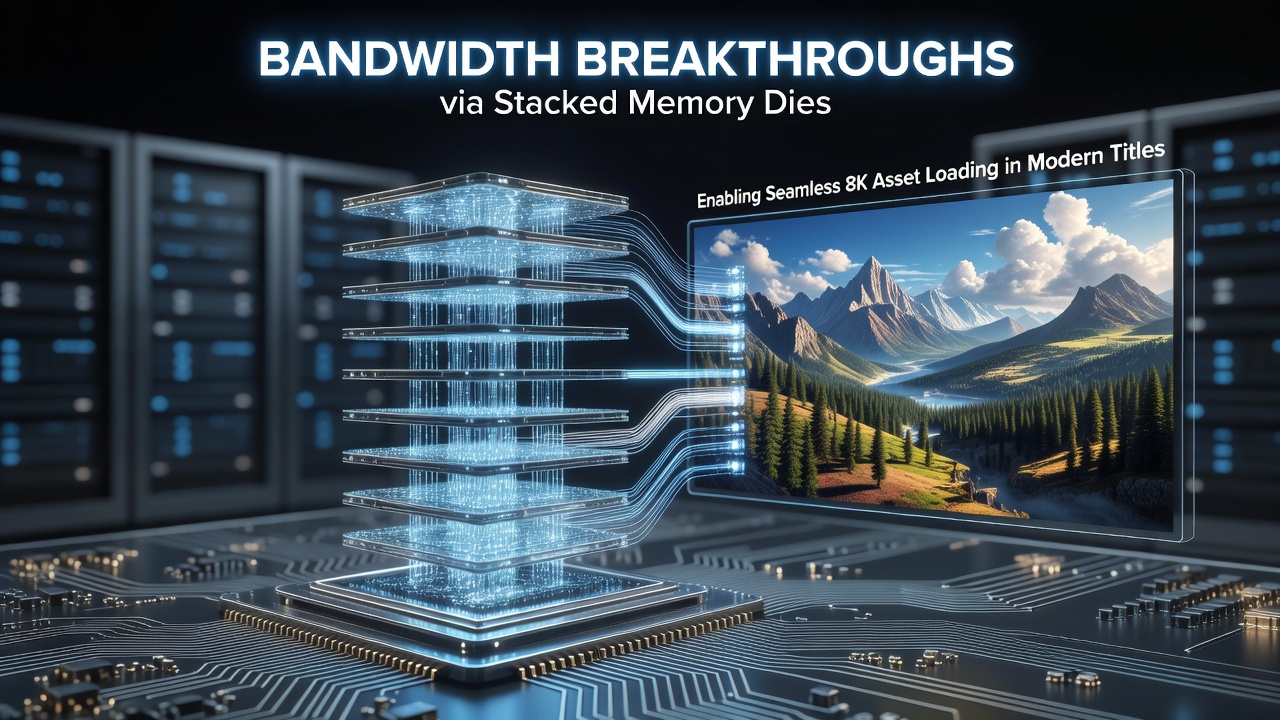
Stacked Memory Dies Revolutionize Bandwidth in 8K Gaming Environments
Stacked memory architectures have emerged as a pivotal development in graphics hardware, where multiple DRAM dies are layered vertically to deliver elevated data throughput for demanding visual workloads. This configuration supports the rapid transfer of 8K resolution assets, including textures, geometry, and shaders, directly into GPU pipelines without the interruptions common in earlier memory layouts. Engineers at major semiconductor firms have refined through-silicon via connections that link these dies, allowing bandwidth figures to climb well beyond traditional GDDR solutions while maintaining compact footprints on graphics cards and consoles.
Core Mechanics Behind Vertical Memory Stacking
High Bandwidth Memory, often abbreviated as HBM, forms the foundation of these advances because each stack incorporates several DRAM dies interconnected through thousands of vertical channels. Data pathways shorten dramatically compared with planar arrangements, which reduces latency and permits sustained transfer rates exceeding 1 TB/s in current implementations. Researchers have documented how this vertical integration minimizes signal interference across the stack, a factor that becomes critical when engines stream ultra-high-definition assets in real time. In June 2026 several hardware vendors demonstrated updated HBM variants at industry events, confirming their integration into next-generation graphics processors aimed at seamless 8K experiences.
Memory controllers have adapted to manage the increased parallelism offered by stacked configurations, routing requests across multiple channels simultaneously. This parallelism allows game engines to load large mipmapped textures or volumetric data sets in parallel streams rather than sequential bursts. Observers note that titles leveraging these capabilities exhibit fewer pop-in artifacts because asset data arrives at the GPU well ahead of rendering demands. Those who have benchmarked systems equipped with HBM3E stacks report consistent frame delivery even when scene complexity spikes, a direct result of the memory subsystem keeping pace with shader and compute workloads.
Integration with Modern Rendering Pipelines
Game developers have begun incorporating explicit memory management calls that exploit stacked die bandwidth for streaming 8K assets from SSDs into GPU memory pools. Engines such as Unreal Engine 5 and Unity’s latest HDRP builds include hooks that prioritize high-priority texture tiles, ensuring they reside in the fastest memory layers. Because stacked memory offers both capacity and speed within the same package, developers can maintain higher levels of detail across expansive open worlds without resorting to aggressive compression that degrades visual fidelity. Figures from hardware validation labs indicate that load times for 8K texture sets drop by measurable margins when HBM stacks replace conventional memory, particularly during transitions between detailed environments.

Thermal considerations receive careful attention during stack design because vertical layering concentrates heat, yet advanced interposers and cooling solutions have kept junction temperatures within acceptable ranges during prolonged sessions. Power delivery networks have likewise evolved to supply stable voltage across the dense interconnects, preventing throttling that would otherwise interrupt asset streams. Data from independent testing facilities shows that systems utilizing these memory stacks sustain peak bandwidth for extended periods, supporting continuous 8K asset loading even under heavy multi-threaded draw calls.
Industry Adoption and Performance Metrics
Console and PC hardware released in recent cycles have incorporated stacked memory as standard, enabling developers to target 8K output with confidence that the memory subsystem will not become the limiting factor. Semiconductor Industry Association reports highlight year-over-year increases in HBM production volumes, reflecting broader adoption across graphics and accelerator markets. European research consortia have contributed complementary studies on interconnect reliability, confirming that stacked configurations maintain signal integrity across temperature cycles typical of gaming hardware.
Real-world titles demonstrate the practical impact through reduced streaming stalls when players traverse detailed environments at 8K resolutions. Asset streaming budgets that once required heavy level-of-detail reductions now accommodate native 8K maps because the memory bandwidth accommodates the required data rates. Those monitoring frame-time consistency across multiple platforms note that variance decreases when stacked memory handles the bulk of texture traffic, freeing other system resources for physics and AI calculations.
Future Scaling and Standardization Efforts
Standards bodies continue refining specifications for subsequent HBM generations, focusing on taller stacks, faster signaling rates, and improved power efficiency. Academic groups have published models predicting further bandwidth doublings within the next two process nodes, which would support even denser 8K asset libraries and emerging volumetric capture techniques. Industry participants anticipate that these memory innovations will remain central to graphics roadmaps because they directly address the data movement challenges inherent in high-resolution real-time rendering.
Conclusion
Stacked memory die technology has established itself as an enabling factor for fluid 8K asset delivery in current and upcoming titles. Vertical integration of DRAM layers supplies the bandwidth necessary to keep pace with evolving rendering demands, while ongoing refinements in interconnects, controllers, and thermal management sustain reliable operation. As production volumes rise and standards evolve, the approach continues to underpin performance gains across gaming hardware platforms.